CAD thatsimulates.
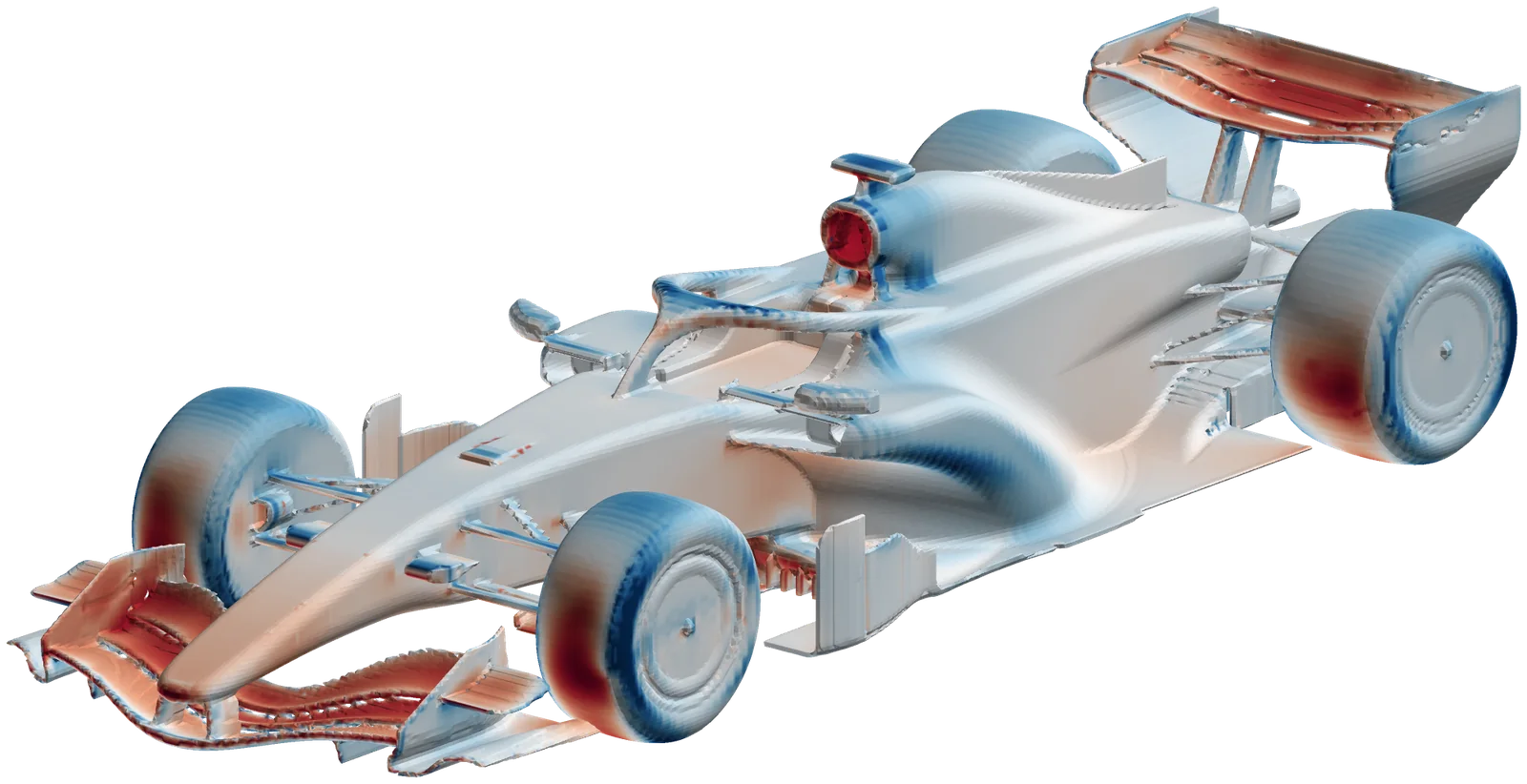
Geometry, meshing, CFD, FE and post-processing in one pipeline, running on the GPU. A design change goes from shape to a full aerodynamic report in seconds.
Shape to answer on one device.
No file conversion, no hand meshing, no solver tuning. The geometry feeds every solver directly, and the whole chain runs where the data already is: on the GPU.
Geometry
A CAD kernel written from scratch: exact Booleans, smooth blends, sketches with fillets, extrude, revolve, pipe and patterns. STL and STEP parts join as nodes.
Mesh
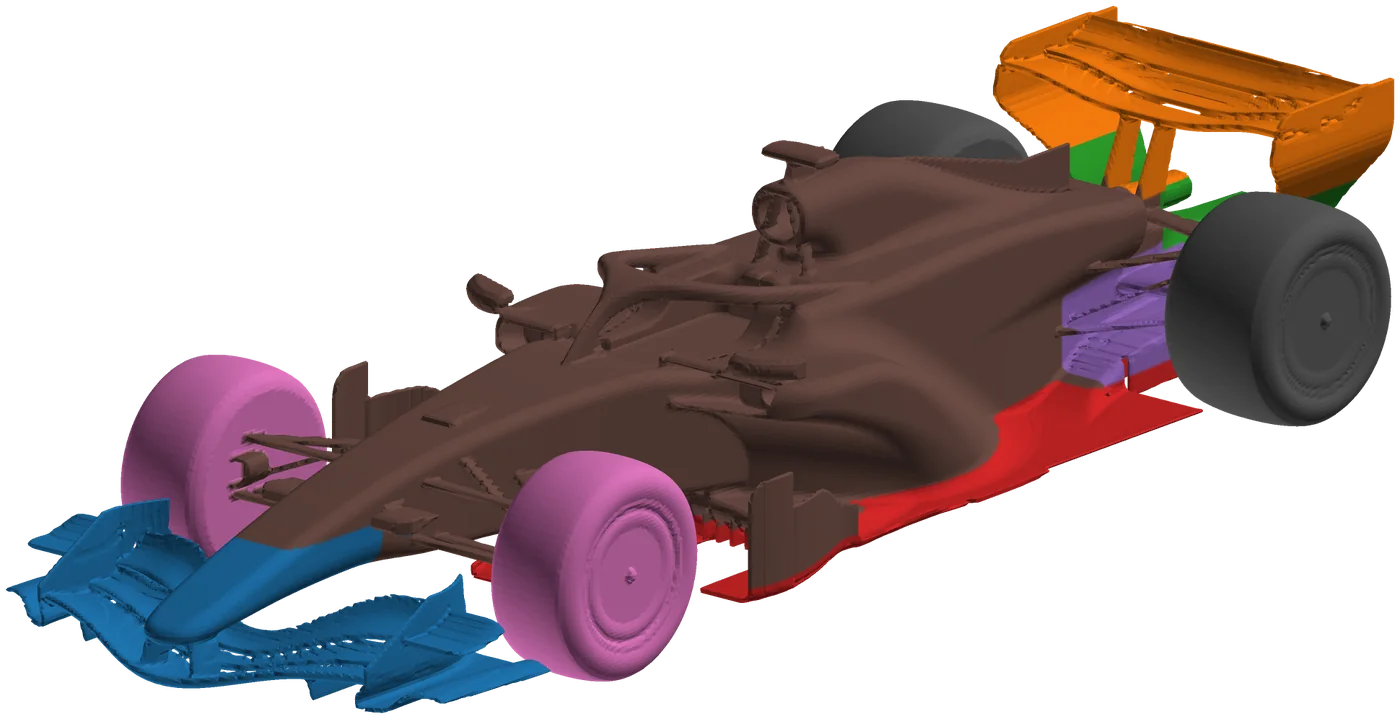
Graded Cartesian grids with planar-exact cut cells follow from the geometry, refined where the part needs it. There is no meshing step to babysit.
Solve
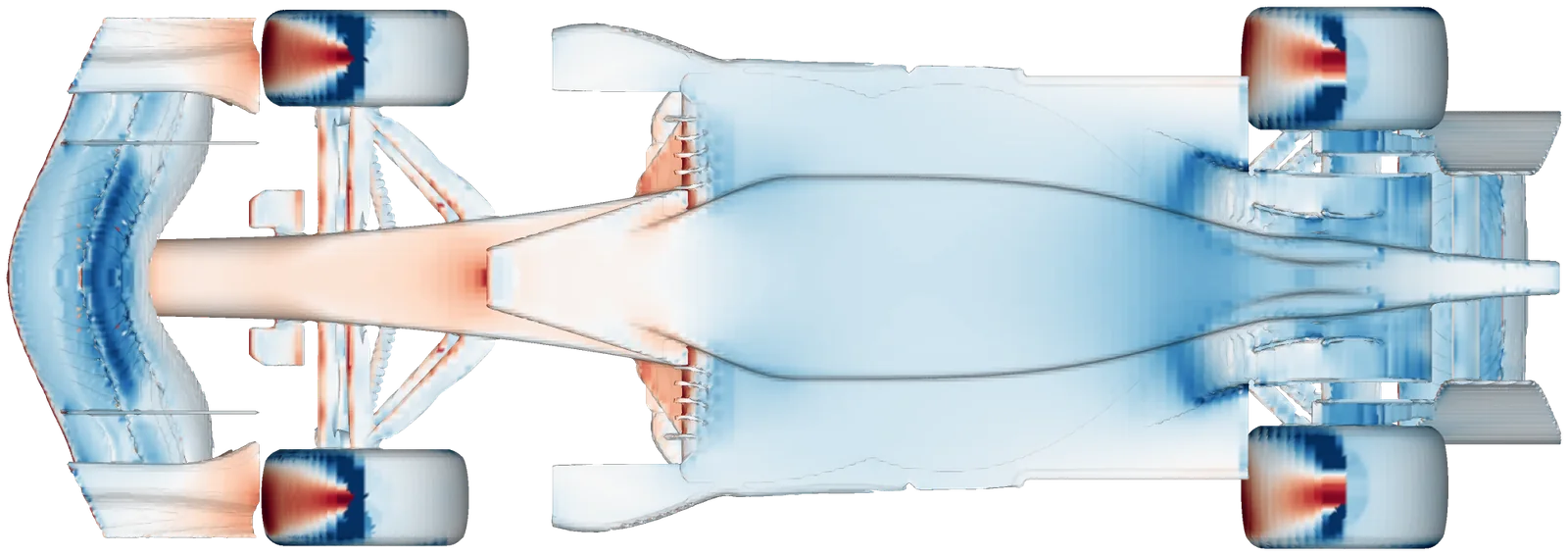
RANS k-ω SST aerodynamics with moving ground and rotating wheels on the GPU. Flow, heat, structures and additive manufacturing run in the same runner.

Post-process
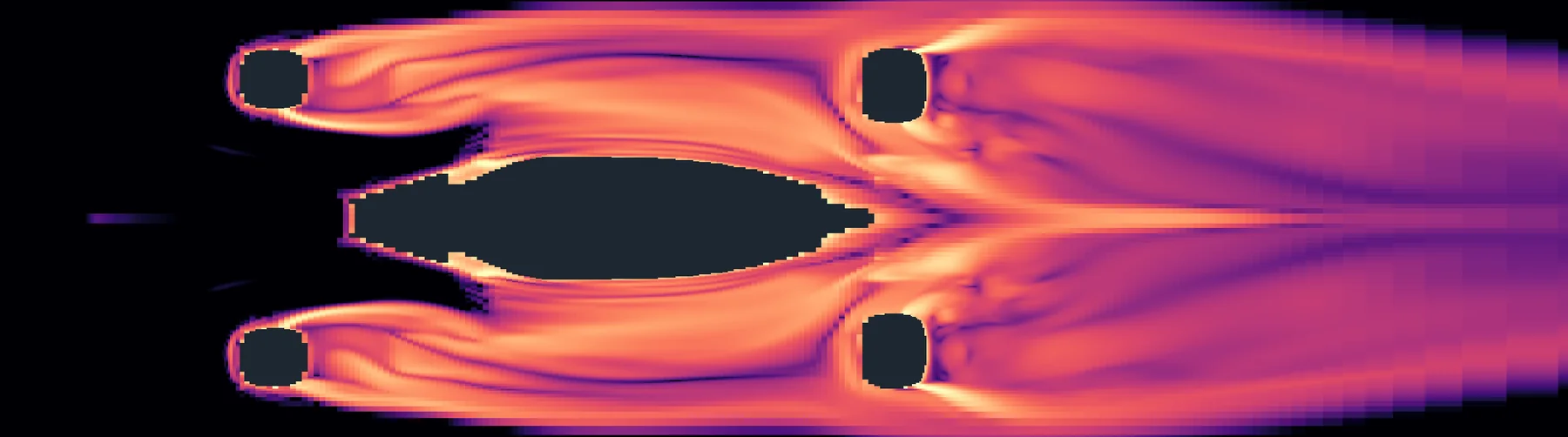
Forces with a per-component split, surface and floor pressure, wake planes, vorticity and VTK fields in one report, with every numerical risk flagged as a warning.
The datasheet.
What ships today and where it runs. Everything here is covered by automated checks.
| Module | Method | Runs on |
|---|---|---|
| CAD kernel | Implicit geometry, exact Booleans and blends, sketches, extrude, revolve, pipe, patterns; STL and STEP import; watertight STL mesher | GPU + Rust |
| Meshing | Graded Cartesian grids with planar-exact cut cells, built from the geometry | GPU |
| External aerodynamics | Steady RANS k-ω SST with wall functions, moving ground, rotating wheels | GPU |
| Structures (FE) | Matrix-free voxel and finite-cell elasticity with multigrid: statics, modal (also prestressed), harmonic response, linear buckling | CPU · GPU next |
| Internal flow and heat | Laminar steady and time-accurate flow, conjugate heat transfer, coupled to stress | CPU |
| Additive manufacturing | Printability, build direction, supports, trapped powder, thin walls, LPBF distortion | CPU |
| Post-processing | Force split, surface and floor pressure, wake planes, vorticity, VTK; GPU rasterizer for surface renders | GPU |
| Agents | MCP tool server: an AI agent writes a spec, runs it and reads the KPIs, warnings and report | Any device |
Any GPU. No lock-in.
One set of kernels runs through Vulkan, Metal and DX12: NVIDIA data-centre cards, AMD and Apple laptops, even the integrated GPU of a mini PC.
- Every stage on the deviceGeometry, grid, solver, forces, running means and surface renders. Post-processing stays on the GPU between iterations.
- Bit-reproducibleRepeated runs are bit-identical, and every GPU kernel is checked against its CPU twin on T4, L4, A10G, L40S, A100, H100, Radeon 680M and a software driver.
- Portable by designWGSL kernels through wgpu: Vulkan on NVIDIA and AMD, Metal on Apple, DX12 on Windows. No CUDA required.
Faster than OpenFOAM. True to the wind tunnel.
Ahmed body with a 25° slant, k-ω SST with wall functions, same Apple M3 Pro laptop. Time from geometry to a settled drag, meshing included.
| Run | Cells | Time to settled drag | Speed-up | Cd | Cl |
|---|---|---|---|---|---|
| LeonSim, GPU (Metal) | 636 k | 3.6 s | 9.6× | 0.289 | 0.381 |
| LeonSim, native Rust CPU, 11 threads | 636 k | 23.3 s | 1.5× | 0.276 | 0.390 |
| OpenFOAM v2412 (snappyHexMesh + simpleFoam) | 327 k | 34.8 s | 1.0× | 0.313 | 0.381 |
| Wind tunnel (Ahmed 1984 / Meile 2011) | 0.285 / 0.299 | 0.345 |
OpenFOAM is the best of 2, 5 and 8 ranks. The Ahmed wake oscillates rather than reaching a fixed point, so coefficients move by a few percent with the solver path; with the stricter settle-then-average protocol all LeonSim back-ends agree (Cd 0.291 to 0.298) and the GPU is about 4× faster than OpenFOAM.
From an STL to a full aero report.
Formula 1 is the hardest test we run: thin wings, ground effect, rotating wheels and a mesh full of display-model defects. One command does all of it.
From a public STL, repaired automatically.
Holes, loose patches, thin plates and open rims are fixed on import, then the car is solved with a moving ground and rotating wheels.
8.5 M cells, 10 minutes on an AMD Radeon 680M. Drag ±2 %, downforce ±10 % (why).
Read the full study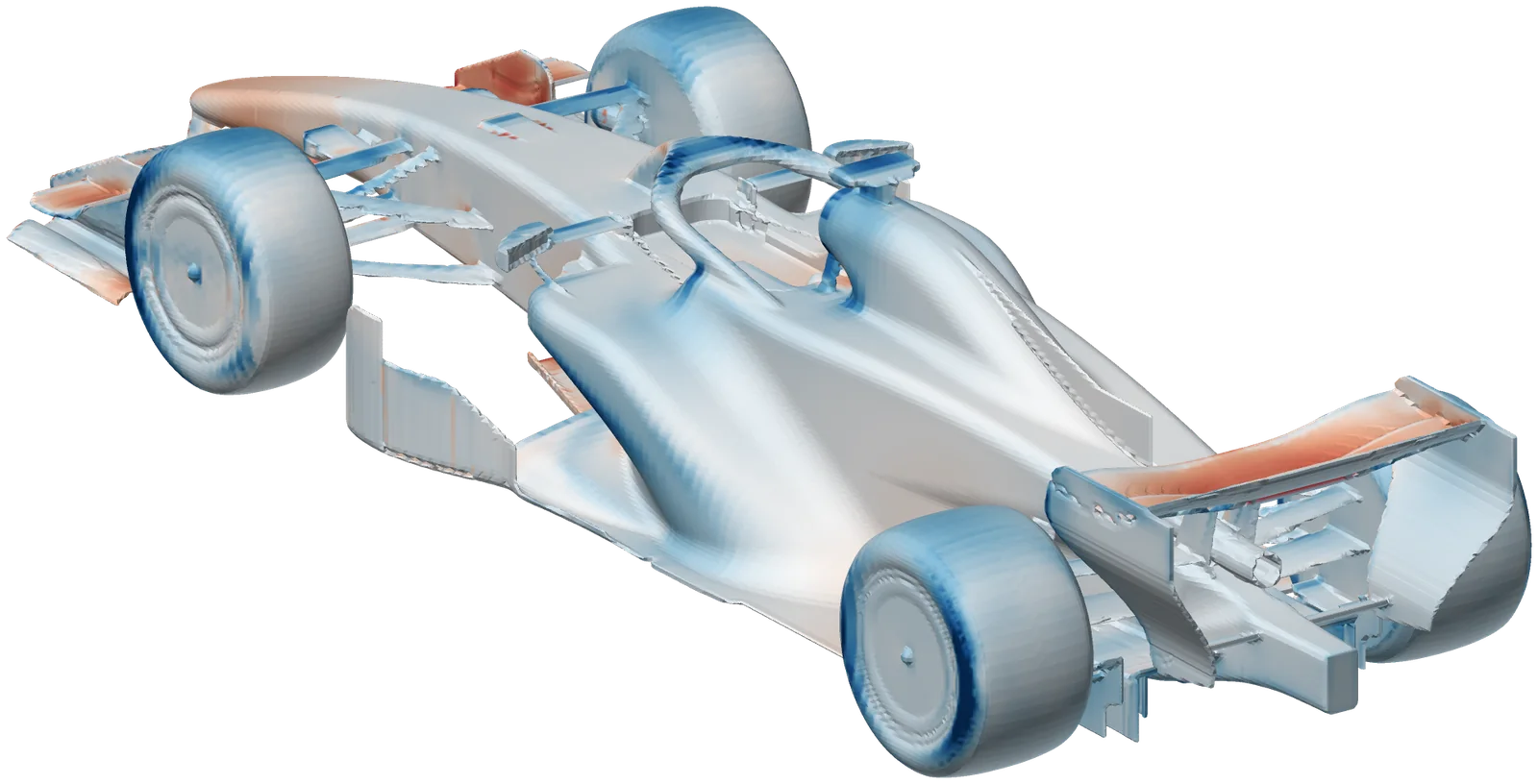
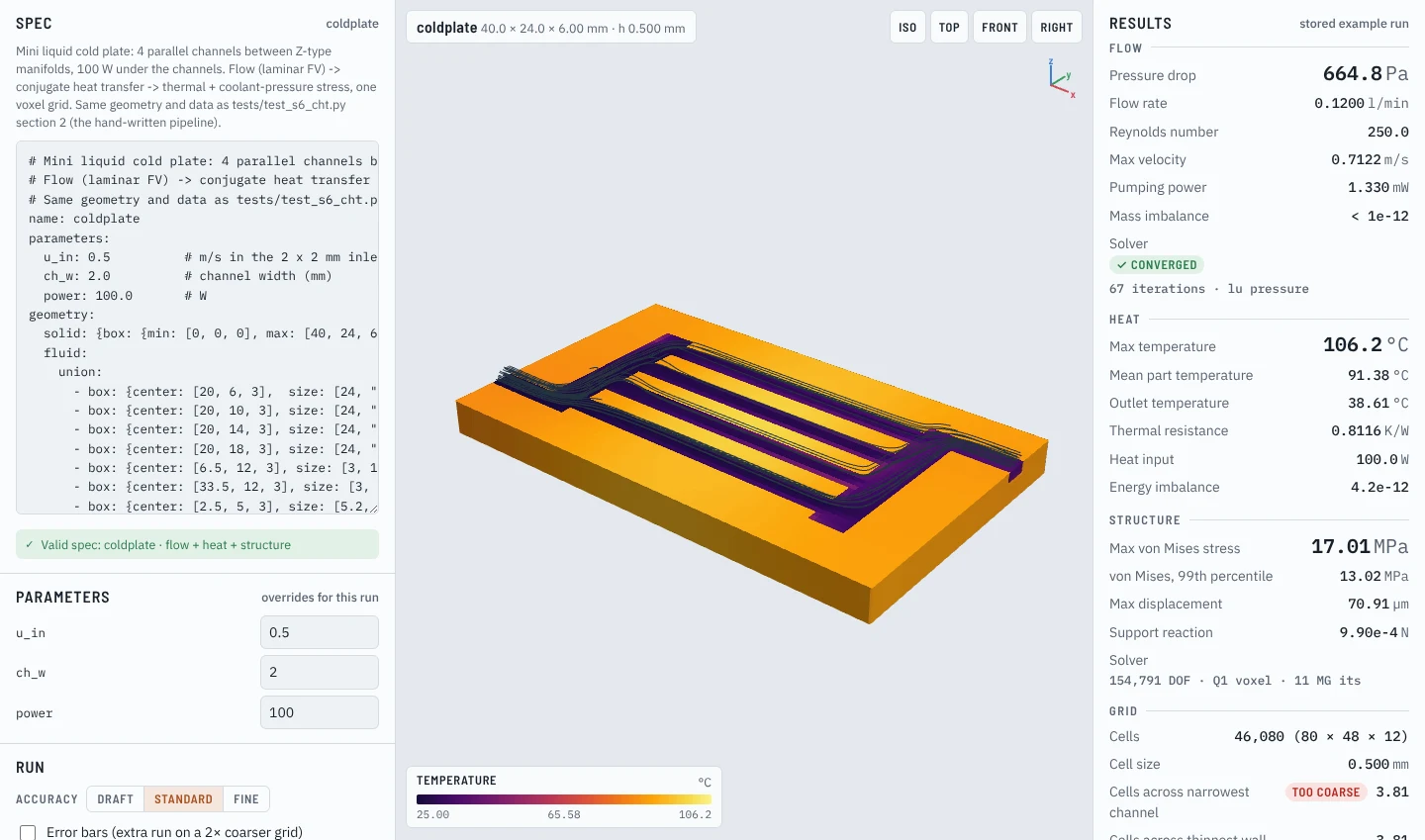
Drive it from a browser, a script or an AI agent.
Write a spec, run it and explore the result in 3D: colour by temperature, stress or pressure, follow streamlines, cut sections, animate mode shapes, and click the part to place supports, loads and heat sources.
# a full F1 aero report on the GPU
$ leonsim aero f1 --level medium --backend gpu
# flow, heat and stress of a cold plate
$ leonsim run examples/cases/coldplate.yaml
# the Workbench, and the MCP server for agents
$ leonsim web --open
$ leonsim mcpWhat comes next.
Not shipped yet, in the order we are building it.
See a full simulation in your browser.
The Workbench demo holds stored results of 18 example cases, from a cold plate to a tuning fork.