F1 2026 Concept CFD
The Sketchfab “F1 2026 concept” model, imported into LeonSim from its STL and solved on three grids up to 8.5 million cells on an AMD Radeon 680M (a mini PC’s integrated GPU). On the fine grid it makes 1.53 m² of downforce for 1.09 m² of drag, with 28.6 % of the load on the front axle.
What was run
The model is a 1.16 million-triangle STL in millimetres: 5.39 m long, 1.88 m wide, a 3.40 m wheelbase and 719 mm tyres, inside the 2026 envelope. The car runs level, with the plank 31 mm above the road at both axles, and the flaps sit as the modeller left them (2026 active aero is not modelled as a separate mode).
It is a display model, so it needed repair before a solver could use it. The body had two open slots along the cockpit, about a hundred loose triangles, and wheels whose rims leave thin air gaps around the tyre bead and the upright. Many rear-wing elements and endplates are 6–12 mm thick, one cell or less on these grids. How each was handled is in What changed in LeonSim.
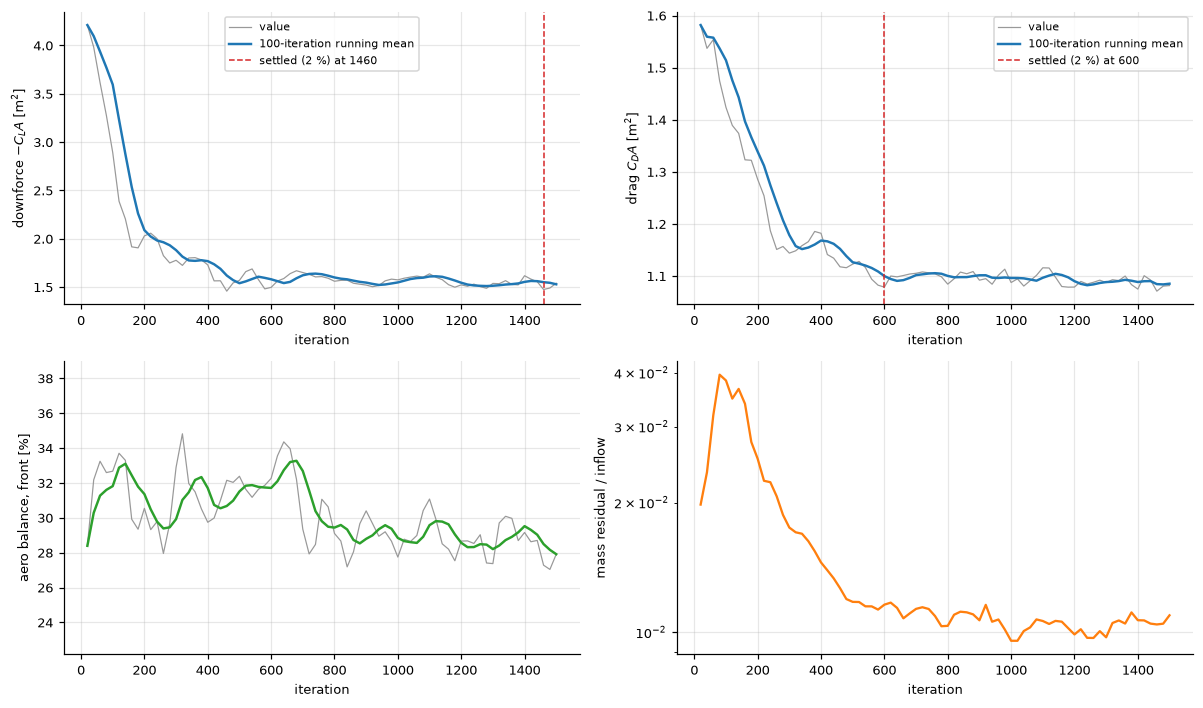
Each grid ran on the GPU from a cold start with a 30-iteration under-relaxed ramp; coefficients are averages of the last iterations (150 on coarse, 300 on medium and fine). The floor-edge grid band described below was on for all three.
Results on three grids
The downforce moves +13 % from medium to fine and the drag +0 %. The coarse grid is too coarse for this geometry: its wing cells are 16–22 mm, larger than most of the wing elements and slot gaps, so the front wing hardly loads and the car shows front lift. Treat medium and fine as the result and the change between them as the grid uncertainty.
Forces against grid size
| Grid | Cells | −CL·A [m²] | CD·A [m²] | L/D | Front balance | Downforce σ | Iterations | GPU time |
|---|---|---|---|---|---|---|---|---|
| coarse | 1.63 M | 0.293 | 1.019 | 0.29 | -90.2 % | ±0.041 | 600 | 0.9 min |
| medium | 4.30 M | 1.352 | 1.088 | 1.24 | 31.0 % | ±0.048 | 1000 | 4.1 min |
| fine | 8.50 M | 1.533 | 1.092 | 1.40 | 28.6 % | ±0.037 | 1500 | 10.4 min |
Where the load comes from
The floor and diffuser make 1.29 m², the largest share, as on any ground-effect car. The front wing and nose make 0.72 m² and the rear wing 0.48 m². Against that, the body lifts by -0.76 m² and the four wheels by -0.18 m².
The body’s lift sits on its upper surfaces from the nose to the engine cover, strongest on the sidepod shoulders and around the cockpit. The display model’s cooling inlets (sidepods and the roll-hoop airbox) are closed faces: air that a real car swallows through its radiators stagnates in front of them and spills over the shoulders. That is the largest reason this car falls short of a real one.
Downforce by component, fine grid
| Component (−CL·A, m²) | coarse | medium | fine | CD·A, fine |
|---|---|---|---|---|
| Front wing + nose | +0.20 | +0.70 | +0.72 | 0.168 |
| Floor | +0.81 | +1.00 | +1.09 | 0.086 |
| Diffuser | +0.12 | +0.17 | +0.20 | 0.097 |
| Rear wing | +0.23 | +0.46 | +0.48 | 0.121 |
| Beam wing | -0.00 | -0.01 | -0.01 | 0.009 |
| Front wheels | -0.16 | -0.12 | -0.11 | 0.110 |
| Rear wheels | -0.15 | -0.10 | -0.07 | 0.243 |
| Body (chassis, sidepods, halo, suspension) | -0.75 | -0.75 | -0.76 | 0.260 |
The flow
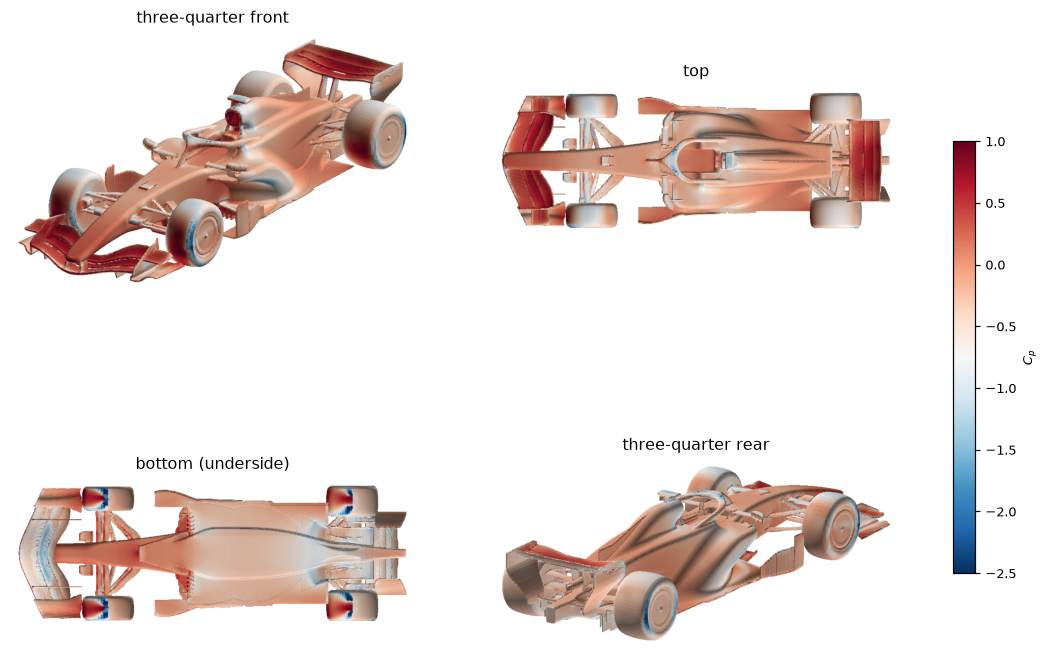
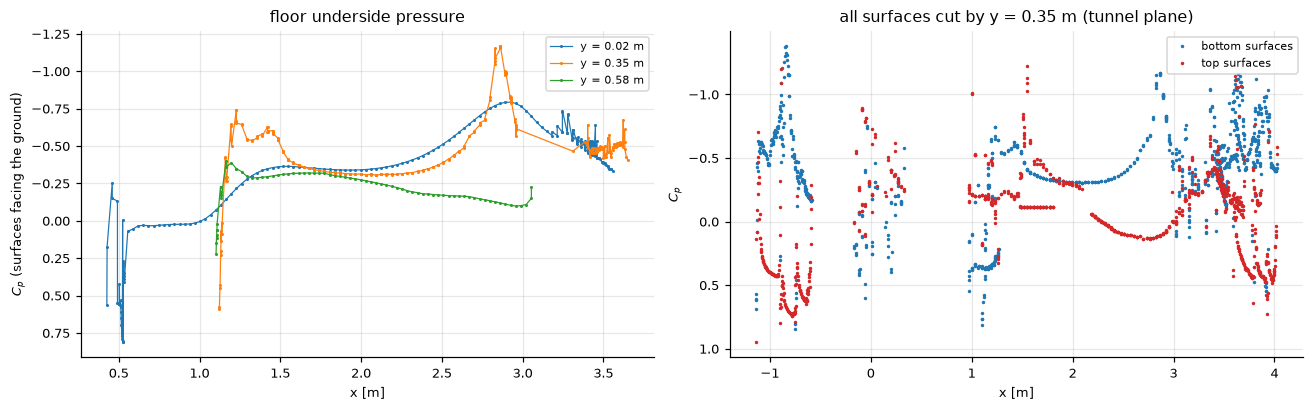
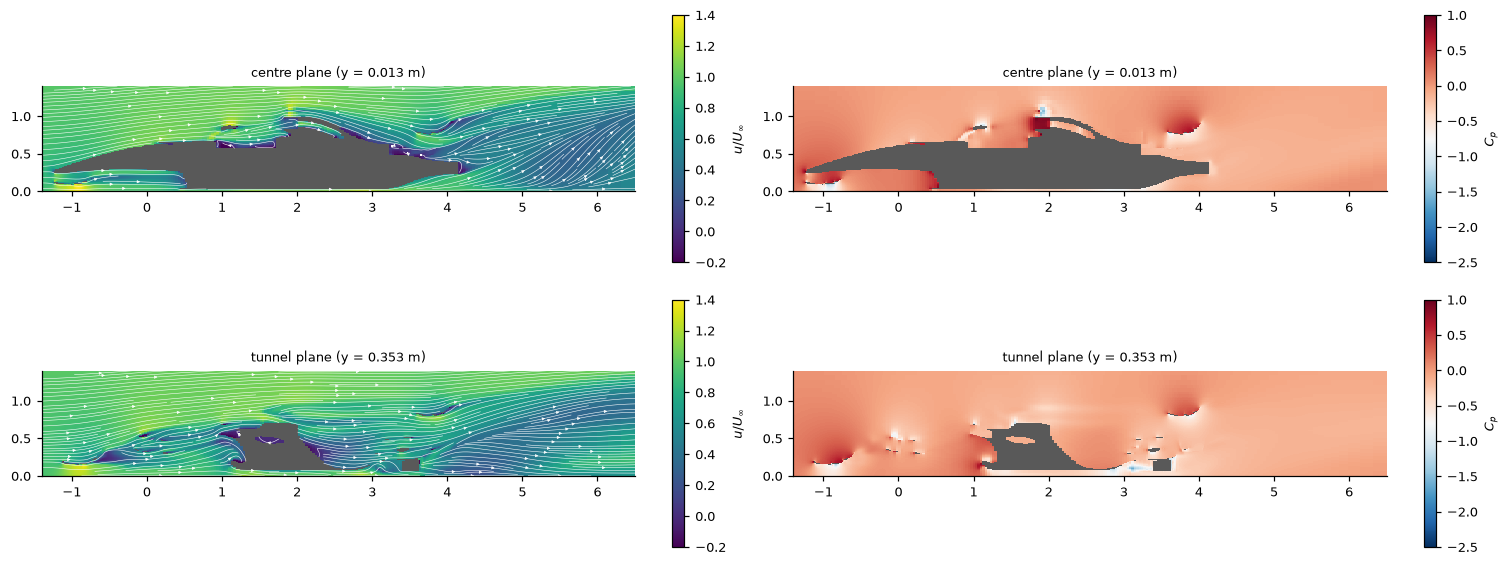
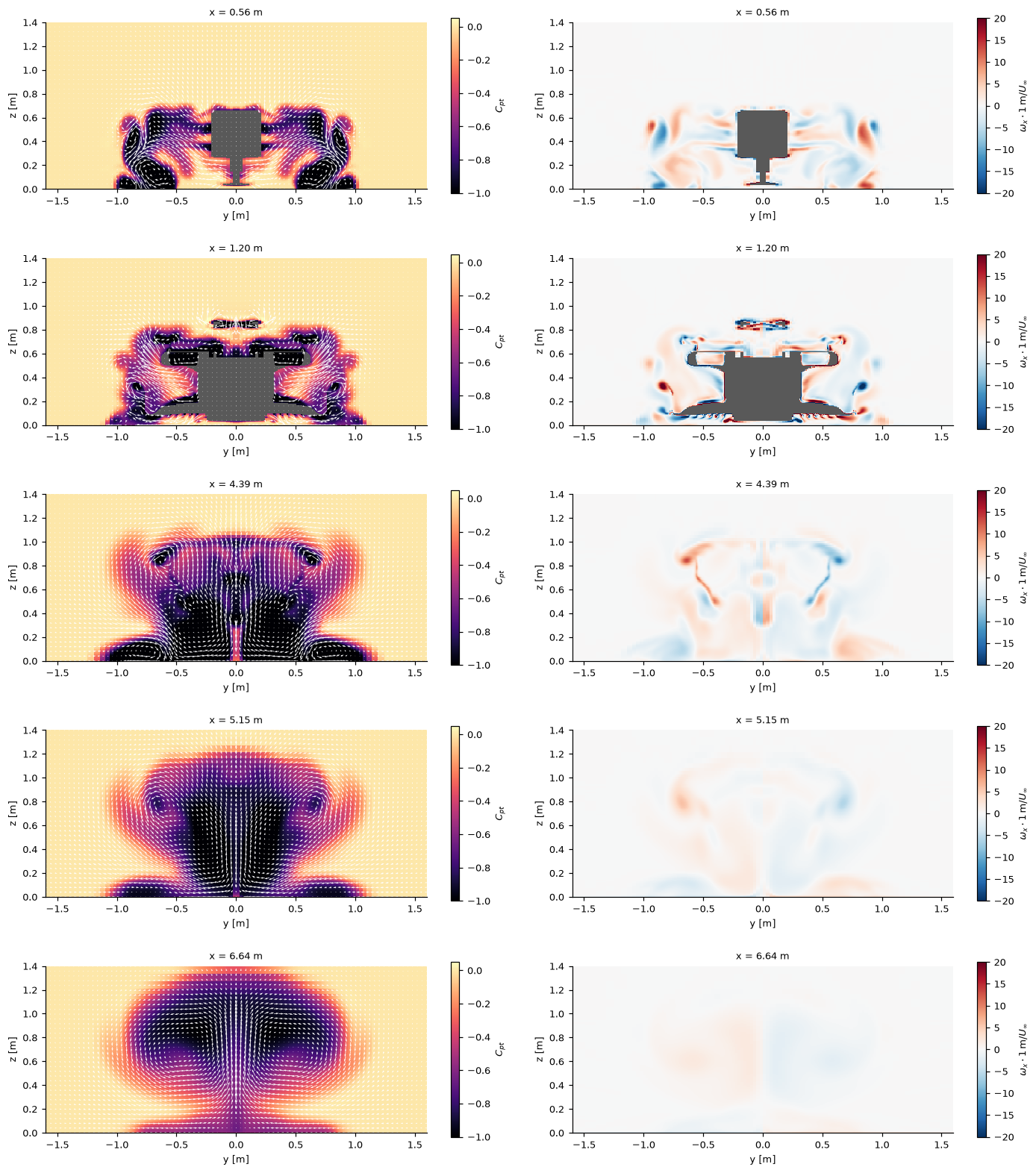
What changed in LeonSim
The work on this car added the following to LeonSim. The code is in the repository; this page is results/aero/f1_2026/report/.
Any F1 STL as a car
leonsim.cad.stl_car turns an STL into the same car object as LeonSim’s parametric model, so the F1 grids, the GPU solver and the report work on it unchanged. It finds the wheels, sets the frame (front axle at x = 0, road at z = 0), samples the body once at 4 mm with a sign that tolerates holes and overlapping shells, splits forces by region, sets ride height and rake, and caches the field (90 s to sample, 4 s to reload).
Floor-edge grid band
LeonSim’s F1 grids used one sideways spacing for the whole car, so the 5 cm gap between the floor edge and the rear tyre held one or two cells. A refined band across the floor edge and tyres (hyf) raises the parametric car’s downforce by up to 44 % on the coarse grid and from 1.83 to 2.07 m² on the medium grid, with no change to the car. The old grids under-predicted the floor.
Stable wheels
Real wheel geometry leaves thin air gaps between the rotating tyre and static parts, and the solver diverged on them within 3–60 iterations. Wheels are now closed with rim covers (standard on F1 cars since 2022), filled on the inboard side where the brake duct sits.
Thin parts
Parts thinner than 16 mm grow to 16 mm, measured inside each part so thick surfaces stay where they are. Without it, a 6–12 mm endplate is one cell thick and air passes through it; that blew up the first fine run.
AMD GPU
The Radeon 680M was unused: the account running LeonSim was not in the render group, so Vulkan saw only the software renderer. With it enabled, the GPU solver runs a coarse F1 case in 30 s (the reference Apple M3 Pro takes 36 s) and the fine grid at 0.42 s per iteration. It is the first recorded run of LeonSim’s GPU path on non-Apple hardware, The GPU kernel test (S27) passes 3 of its 4 checks: every kernel matches the CPU reference to float32 round-off and 50 solver iterations agree with the CPU within 10⁻⁴. The fourth fails only for a non-default multigrid option, whose float32 accuracy floor on this driver is 3.2 × 10⁻⁴ against a 2 × 10⁻⁴ limit; the default pressure solver used for every run here is within its limit (3.9 × 10⁻⁵ against 10⁻⁴).
Tests and docs
A new test, S29, builds a synthetic car with the same defects (thin plate, open patch, offset frame) and checks wheel detection, framing, sign, thickening, rim covers, ride heights, the cache and the force split. docs/f1.md has a new section on STL cars and the floor-edge band.
The floor-edge band on LeonSim’s own car
The finding that changed the most numbers came from LeonSim’s parametric car, before the 2026 model arrived. Only the grid changes between these runs; the car is identical.
Downforce against floor-edge spacing
Parametric 2022 car, coarse grid
| Grid, band | Cells | −CL·A | CD·A | Floor | Balance |
|---|---|---|---|---|---|
| coarse, none (50 mm) | 0.83 M | 1.286 | 1.074 | 0.78 | 42.6 % |
| coarse, 16 mm | 1.04 M | 1.594 | 1.002 | 0.97 | 45.7 % |
| coarse, 12 mm | 1.24 M | 1.728 | 1.012 | 1.08 | 46.0 % |
| coarse, 8 mm | 1.64 M | 1.851 | 1.020 | 1.22 | 44.8 % |
| medium, none (34 mm) | 2.51 M | 1.833 | 1.171 | 0.97 | 37.9 % |
| medium, 8 mm | 4.29 M | 2.071 | 1.103 | 1.13 | 42.5 % |
How far to trust it
- Grid. Downforce changed +13 % from medium to fine. LeonSim’s grids are tensor-product, so most cells sit in empty air; industrial F1 models use 30–80 million cells concentrated at the surface.
- Iterations. A 2000-iteration rerun of the medium grid (9 Oct 2026) shows the downforce still drifting down: 300-iteration block means go 1.36, 1.24, 1.22, 1.23, 1.20, 1.17 m², while drag settles at 1.07–1.08 m². The medium value above is the high end of a 1.17–1.35 band, so part of the medium-to-fine change is the iteration count, not the grid. Read a single run’s downforce as ±10 % and its drag as ±2 %.
- Geometry. Closed cooling inlets, wings thickened to at least 16 mm (which narrows the slot gaps by the same amount) and wheels with rim covers. The model is a visual concept, not a team surface.
- Physics. Steady RANS with wall functions. Separation, tyre wakes and the diffuser are where it is least reliable, and the forces oscillate by about ±0.037 m² around their mean.
- No reference data. There are no published forces for this model. Public statements put 2026 cars at roughly 30 % less downforce than the 2022–25 cars (about 3.5–5 m²), which this result does not reach.
Next steps
- Model cooling flow: open the sidepod and airbox inlets into a porous radiator zone, to remove most of the body lift.
- Map ride height and rake on the medium grid (
ride_front,ride_rearare in place; about 5 minutes per point on this GPU). - Refine around the wings at the surface rather than in slabs, so the slot gaps resolve without thickening.
- Add the 2026 active-aero straight-line mode by rotating the flap elements, which needs the flaps separated in the CAD.